Today's
EarthStation1.com 15% Off Commemorative Memorial Title: The
Machine That Changed The World The Computer + Bonus 3 MP4s Or DVDs
Today, December 3, 2025
( #JCKaelin here: My younger Kevin is one
such child, and we moved to Edison, New Jersey in 1970 so that he
could attend the recently constructed Cerebral Palsy Association
of Middlesex County Center in Roosevelt Park. IDEA gave Kevin the
opportunity to go to a regular public school in 1975 :) )
========= December 3: International Disability Day (International
Day Of Persons With Disabilities, International Day Of People With
Disability): -- A day that helps us focus on challenges faced by
people living with not just mental or physical disabilities, but
rather encompasses all known disabilities, from Autism to Down
Syndrome to Multiple Sclerosis, to champion an inclusive society
for people living with them, to encourage a better understanding
of people affected by disabilities and to help make people more
aware of their rights, dignity, and welfare. and to raise
awareness about the benefits of integrating disabled persons into
every aspect of life, from economic to political to social and
cultural. Celebrating this day also highlights the need for equal
opportunities in education, employment, and healthcare.The spirit
of the day is to ensure that all people in the world have equal
opportunities for work, play, health, and success. People with
disabilities can be and very often are contributing and valued
members of society, and today is all about appreciating them. It
reminds us that we all benefit when society includes and supports
everyone. The aim is to ensure that everyone, regardless of
ability, can lead fulfilling lives and contribute to their
communities. Everything started in 1976, when the United Nations
General Assembly made the decision that 1981 should be the
International Year of Disabled Persons. The 5 years between the
making of that decision and the actual Year of Disabled Persons
were spent contemplating the hardships of the disabled, how the
opportunities of the disabled could be equalized, and how to
ensure the disabled take part fully in community life enjoying all
of the rights and benefits non-disabled citizens have. Another
issue that was touched on was how world governments could go about
preventing disabilities from touching people in the first place,
so much of the talk was about the viruses and other illnesses that
lead to various kinds of disability. The decade between 1983 and
1992 was later proclaimed the United Nations Decade of Disabled
Persons, and during that time, all of the concepts previously
created became part of one long process that was implemented to
improve the lives of disabled people worldwide. On Sale @ 15% Off
Discount Till Midnight PT!
https://store.earthstation1.com/the-machine-that-changed-the-world-the-computer-dvd-mp4-downloa4.html
Today's
EarthStation1.com 15% Off Commemorative Memorial Title: The Mostly
Mozart Festival Orchestra 1990 DVD, Download, Flash Drive
Today, December 3, 2025
( #JCKaelin here: I have had WQXR playing
24/7 for more than two decades on my kitchen radio! (It was the
station that led Ernie Kovacs to love classical music, and to
incorporate it into many of his visual performance pieces and
comedy sketches.) AND I'm a monthly supporter of the station too,
and so can you be! You can tune in to and support WQXR anywhere in
the world by visiting WQXR.org and spending your time (and your
vital donations) loving these immortal sounds along with me,
Ernie, and all those who love and support classical music! :) )
========= December 3: WQXR Day: -- December 3, 1936: WQXRN (Now
WQXR-FM 105.9 FM), New York's only all-classical radio station,
becomes the first licensed high fidelity broadcaster in the U.S.
after changing its call letters from W2XR, operated by the
Interstate Broadcasting Company, and first goes on-air live at 4
PM. On December 2, 2021, New York City Mayor Bill de Blasio
declared the December 3 date to be WQXR Day in recognition. "On
the occasion of its 85th Anniversary, I am pleased to recognize
WQXR for its tremendous contributions to our city's dynamic
cultural landscape," Mayor de Blasio's proclamation reads in
part. "I am proud to join in applauding its knowledgeable
program hosts and producers, its generous supporters, and everyone
associated with this acclaimed New York City institution for their
efforts to enrich our performing arts sector, strengthen our vital
creative community, and share the joys of classical music with New
Yorkers of all backgrounds. Together, we are forging a brighter,
more harmonious future for all." WQXR is an American
non-commercial classical radio station, licensed to Newark, New
Jersey, and serving the North Jersey and New York City area. It is
owned by the nonprofit organization New York Public Radio (NYPR),
which also operates WNYC (AM), WNYC-FM and the four-station New
Jersey Public Radio group. WQXR-FM broadcasts from studios and
offices located in the Hudson Square neighborhood in lower
Manhattan and its transmitter is located at the Empire State
Building. The station is the core audio service for NYPR's WQXR
brand. Fittingly for a station whose pioneering pedigree is
embedded in its name (the X is for "Experimental"), WQXR
has been responsible for an impressive number of radio "firsts"
-- first to go "hifi" (in 1936), first to use tape on
the air (1938), first to broadcast in FM (1939), and first New
York station to experiment with "stereo" (1952) -- but
just one first-and-only. WQXR was founded by John Hogan. In the
late 1920s, he launched a radio station originally called W2XR:
the '2' meant that the station was non-commercial and the 'XR'
stood for 'Experimmental Radio.' WQXR founder John Hogan. Founded
in 1929 by John Vincent Lawless Hogan, W2XR, future radio voice of
the New York Times and for years one of the most renowned radio
stations in the country, was the first radio station to begin its
existence with a television broadcast. The world wasn't ready for
TV on the radio in 1929, but it was wild for wireless, and Hogan,
a former aide-de-camp of radio trailblazer Lee de Forest, was
particularly well-positioned to lift the medium to new heights.
W2XR received its first license in 1934, which cleared it for
non-commercial broadcasts. When Hogan partnered with his old
friend, Elliott M. Sanger, to form the Interstate Broadcasting
Co., Inc. (IBC) two years later, venturing into commercial radio,
it got a literal boost: WQXR increased their output by a factor of
4, quadrupling their wattage from 250 to 1000. The new commercial
licence also forced them to change their name from W2XR to WQXR-2
to Q, it rhymed. The new station grew rapidly over its first few
months, fast becoming one of the most popular stations in the
City, and seizing the opportunities available to the engineering
innovator it was. Taking advantage of its double-the-standard
bandwidth, WQXR pushed their sound to the air in "high
fidelity." Their "program guide," a proto-music
magazine, quickly became a unique and popular favorite. And in
1939, Edwin H. Armstrong selected WQXR as the test case for his
new means for broadcasting, making them the first to hit the air
on the FM band. The station was progressive not only technically,
but socially: early personalities to enjoy airtime on WQXR
included former ACLU director Quincy Howe, the pioneering Lisa
Sergio, and Bennett "Books Are Bullets" Cerf, among
others. The IBC's 1936 application to the FCC stated that the
station would "try to emulate the standards of the [New York]
Times." In this they apparently succeeded: on January 25,
1944 the New York Times purchased WQXR for the princely sum of one
million dollars, though for contractual reasons, the Times
programming wouldn't appear on WQXR airwaves for another two
years. WQXR's relationship with the Times would be a boon to the
city, the station, and the paper, particularly in situations where
news simply could not wait the night-listeners knew it was Truman
Defeats Dewey, not the other way around-and in other times of
crisis, as when New York experienced a newspaper strike in 1963.
During those tumultuous 114 days, WQXR capably buoyed the City's
temporarily lost Times, doubling its news broadcasts and drawing
in more than a few non-striking reporters, ultimately earning the
station's fourth Peabody (of six) for their work. WQXR's early
innovations did not cease either: on October 29, 1952, it would
give its many listeners their first experience with the binaural,
an early taste of stereo. Those tuning in would set two radios 6
feet apart, one tuned to AM, the other FM, and bask in the nascent
novelty that would revolutionize the world of radio and recorded
sound. During its time as the "Radio Station of the New York
Times", listeners would hear from such personalities as
Edward Bernays, Bob Hope, Evans Clark, Alistair Cooke, Van
Cliburn, and June LeBell on a wide variety of programming: news
and talk, music-symphonic to South American-and more. After first
mooting the sale of WQXR in 1971, the New York Times would finally
part ways with the station on July 14, 2009, when they sold it to
its present grateful owners, New York Public Radio, Inc. Today,
WQXR broadcasts a variety of classical music programming,
including Performance Today, Young Artists Showcase, Reflections
from the Keyboard, and the 2016 Peabody Award winning Meet the
Composer. On Sale @ 15% Off Discount Till Midnight PT!
https://store.earthstation1.com/mostly-mozart-festival-orchestra-avery-fisher-hall-19901990.html
Today's
EarthStation1.com 15% Off Commemorative Memorial Title: Portraits
Of American Presidents Nos. 1-42 TV Series MP4 Download DVD
Today, December 3, 2025
December 3, 1800: Elections: Elections In
The United States: The 1800 United States Presidential Election:
-- The Electoral College casts votes for President and Vice
President that resulted in a tie between Thomas Jefferson and
Aaron Burr. The election was held from Friday, October 31 to
Wednesday, December 3, 1800. In what is sometimes referred to as
the "Revolution of 1800", Vice President Thomas
Jefferson of the Democratic-Republican Party defeated incumbent
President John Adams of the Federalist Party. The election was a
realigning election that ushered in a generation of
Democratic-Republican rule.
https://store.earthstation1.com/portraits-of-american-presidents-nos-142-tv-series-mp4-download1424.html
Today's
EarthStation1.com 15% Off Commemorative Memorial Title: Joseph
Conrad: The Secret Agent + 5 Radio Shows DVD MP4 USB Drive
Today, December 3, 2025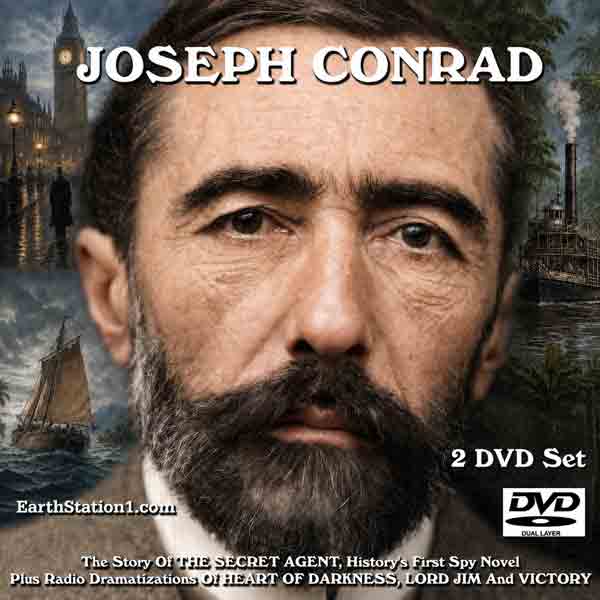
December 3, 1857: #BOTD: #HBD! Joseph
Conrad, Polish-British novelist and short story writer (d. August
3, 1924) is #born Josef Teodor Konrad Korzeniowski in Berdychiv,
Ukraine, Russian Empire. Though he did not speak English fluently
until his twenties, he went on to become one of the greatest
novelists to write in the English language. He joined the British
merchant marine in 1878, and was granted British citizenship in
1886. He was a master prose stylist who brought a non-English
sensibility into English literature. He wrote stories and novels,
many with a nautical setting, that depict trials of the human
spirit in the midst of an impassive, inscrutable universe. Conrad
is considered an early modernist, though his works still contain
elements of 19th-century realism. His narrative style and
anti-heroic characters have influenced numerous authors, and many
films have been adapted from, or inspired by, his works. Writing
in the heyday of the British Empire, Conrad drew on, among other
things, his native Poland's national experiences and his own
experiences in the French and British merchant navies, to create
short stories and novels that reflect aspects of a
European-dominated world, including imperialism and colonialism,
and that profoundly explore the human psyche. Joseph Conrad died
at his house, Oswalds, in Bishopsbourne, Kent, England, probably
of a heart attack, aged 66. He is interred at Canterbury Cemetery,
Canterbury, under a misspelled version of his original Polish
name, as "Joseph Teador Conrad Korzeniowski". Inscribed
on his gravestone are the lines from Edmund Spenser's The Faerie
Queene which he had chosen as the epigraph to his last complete
novel, The Rover: " ========= Sleep after toyle, port after
stormie seas, Ease after warre, death after life, doth greatly
please ========= In 1996 his grave was designated a Grade II
listed structure. On Sale @ 15% Off Discount Till Midnight PT!
https://store.earthstation1.com/joseph-conrad-the-secret-agent-dvd-thriller-novel-backstory.html
Today's
EarthStation1.com 15% Off Commemorative Memorial Title: George B.
McClellan American Civil War General MP4 Download Or DVD
Today, December 3, 2025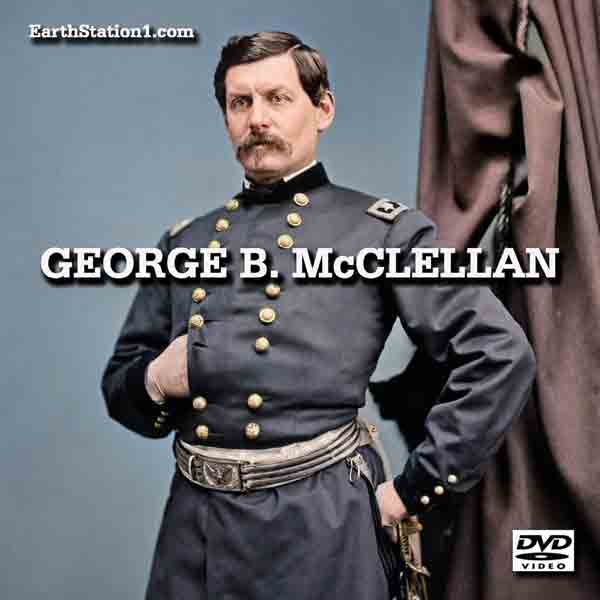
December 3, 1826: #BOTD: George B.
McClellan, American soldier, civil engineer, railroad executive,
and politician who served as the 24th Governor of New Jersey (d.
October 29, 1885) is #born George Brinton McClellanin
Philadelphia, Pennsylvania. A graduate of West Point, McClellan
served with distinction during the Mexican-American War
(1846-1848), and later left the Army to work on railroads until
the outbreak of the American Civil War (1861-1865). Early in the
conflict, McClellan was appointed to the rank of major general and
played an important role in raising a well-trained and organized
army, which would become The Army Of The Potomac in the Eastern
Theater; he served a brief period (November 1861 to March 1862) as
Commanding General of the United States Army of the Union Army.
McClellan organized and led the Union army in the Peninsula
Campaign in southeastern Virginia from March through July 1862. It
was the first large-scale offensive in the Eastern Theater. Making
an amphibious clockwise turning movement around the Confederate
Army in northern Virginia, McClellan's forces turned west to move
up the Virginia Peninsula, between the James River and York River,
landing from Chesapeake Bay, with the Confederate capital,
Richmond, as their objective. Initially, McClellan was somewhat
successful against General Joseph E. Johnston, but the emergence
of General Robert E. Lee to command The Army Of Northern Virginia
turned the subsequent Seven Days Battles into a partial Union
defeat. However, historians note that Lee's victory was in many
ways pyrrhic as he failed to destroy The Army Of The Potomac and
suffered a bloody repulse at Malvern Hill. General McClellan and
President Abraham Lincoln developed a mutual distrust, and
McClellan was privately derisive of his General-in-Chief.
McClellan was removed from command in November in the aftermath of
the 1862 midterm elections. A major contributing factor in this
decision was McClellan's failure to pursue Lee's Army following
the tactically inconclusive but strategic Union victory at the
Battle Of Antietam outside Sharpsburg, Maryland. McClellan never
received another field command and went on to become the
unsuccessful Democratic Party nominee in the 1864 presidential
election against the Republican Lincoln. The effectiveness of his
campaign was damaged when he repudiated his party's platform,
which promised an end to the war and negotiations with the
Confederacy. He served as the 24th Governor of New Jersey from
1878 to 1881; he eventually became a writer, and vigorously
defended his Civil War conduct. George B. McClellan died
unexpectedly at 3 a.m. of a heart attack at age 58 at Orange, New
Jersey, after suffering from chest pains for a few weeks; his
final words were, "I feel easy now. Thank you." He is
buried at Riverview Cemetery in Trenton. Most historians have
judged that McClellan was a poor battlefield general. In recent
decades, however, this view has been challenged by some
historians. On Sale @ 15% Off Discount Till Midnight PT!
https://store.earthstation1.com/george-b-mcclellan-american-civil-war-general-mp4-download-or-dvd.html
Today's
EarthStation1.com 15% Off Commemorative Memorial Title: Air Combat
Aerial Warfare Documentary Series DVD, Download, USB Drive
Today, December 3, 2025
December 3, 1902: #BOTD: #HBD: Mitsuo
Fuchida, Imperial Japanese Navy Air Service and a bomber aviator
(d. May 30, 1976) is #born Fuchida Mitsuo in Katsuragi, Nara,
Japan. He is perhaps best known for leading the first air wave
attacks on Pearl Harbor on December 7, 1941. Working under the
overall fleet commander, Vice Admiral Chuichi Nagumo, Fuchida was
responsible for the coordination of the entire aerial attack.
After the war ended, Fuchida was handed the fall of 1948 a
pamphlet about the life of Jacob DeShazer, a member of the
Doolittle Raid who was captured by the Japanese, which told his
story of imprisonment, torture and his account of an "awakening
to God." This increased Fuchida' interest in Christianity,
and after reading the Bible for himself, he became a Christian. In
May 1950, he met DeShazer, moved to Seattle, Washington and spoke
full-time of his conversion to the Christian faith in
presentations titled "From Pearl Harbor To Calvary". He
traveled the United States and Europe to tell his story. He
settled permanently in the United States but never became a U.S.
citizen. Fuchida Mitsuo died of complications caused by diabetes
in Kashiwara, near Osaka at the age of 73. His burial details are
not publicly known. On Sale @ 15% Off Discount Till Midnight PT!
https://store.earthstation1.com/air-combat-all-13-aerial-warfare-history-tv-shows-collecti13.html
Today's
EarthStation1.com 15% Off Commemorative Memorial Title: Machito: A
Latin Jazz Legacy DVD, MP4 Video Download, USB Flash Drive
Today, December 3, 2025
December 3, 1909: #BOTD: #HBD! Machito,
Cuban singer and maraca player, Latin jazz musician who helped
refine Afro-Cuban jazz and create both Cubop and salsa music (d.
April 15, 1984) is #born Francisco Raul Gutierrez Grillo in either
Havana, Cuba or Tampa, Florida. Machito, was raised in Havana with
the singer Graciela, his foster sister. In New York City, Machito
formed the band the Afro-Cubans in 1940, and with Mario Bauza as
musical director, brought together Cuban rhythms and big band
arrangements in one group. He made numerous recordings from the
1940s to the 1980s, many with Graciela as singer. Machito changed
to a smaller ensemble format in 1975, touring Europe extensively.
He brought his son and daughter into the band, and received a
Grammy Award in 1983, one year before he died. Machito's music had
an effect on the lives of many musicians who played in the
Afro-Cubans over the years, and on those who were attracted to
Latin jazz after hearing him. George Shearing, Dizzy Gillespie,
Charlie Parker and Stan Kenton credited Machito as an influence.
An intersection in East Harlem is named "Machito Square"
in his honor. Machito died of a stroke before a concert in London,
England, collapsing while waiting to go on stage at Ronnie Scott's
club four days prior. His burial details are not publicly
disclosed. On Sale @ 15% Off Discount Till Midnight PT!
https://store.earthstation1.com/machito-a-latin-jazz-legacy-dvd.html
Today's
EarthStation1.com 15% Off Commemorative Memorial Title: Remember
When: It'll Never Fly w/ Dick Cavett Inventions DVD, MP4, USB
Today, December 3, 2025
December 3, 1910: Great Inventions:
Lighting (Illumination): The History Of Lighting: Electric Light:
The History Of Electric Light: Neon Lighting: The History Of Neon
Lighting: -- Modern neon lighting is first demonstrated by Georges
Claude at the 1910 Paris Motor Show. Neon lighting consists of
brightly glowing, electrified glass tubes or bulbs that contain
rarefied neon or other gases. Neon lights are a type of cold
cathode gas-discharge light. A neon tube is a sealed glass tube
with a metal electrode at each end, filled with one of a number of
gases at low pressure. A high potential of several thousand volts
applied to the electrodes ionizes the gas in the tube, causing it
to emit colored light. The color of the light depends on the gas
in the tube. Neon lights were named for neon, a noble gas which
gives off a popular orange light, but other gases and chemicals
are used to produce other colors, such as hydrogen (red), helium
(yellow), carbon dioxide (white), and mercury (blue). Neon tubes
can be fabricated in curving artistic shapes, to form letters or
pictures. They are mainly used to make dramatic, multicolored
glowing signage for advertising, called neon signs, which were
popular from the 1920s to 1960s and again in the 1980s. The term
can also refer to the miniature neon glow lamp, developed in 1917,
about seven years after neon tube lighting. While neon tube lights
are typically meters long, the neon lamps can be less than one
centimeter in length and glow much more dimly than the tube
lights. They are still in use as small indicator lights. Through
the 1970s, neon glow lamps were widely used for numerical displays
in electronics, for small decorative lamps, and as signal
processing devices in circuity. While these lamps are now
antiques, the technology of the neon glow lamp developed into
contemporary plasma displays and televisions. Neon was discovered
in 1898 by the British scientists William Ramsay and Morris W.
Travers. After obtaining pure neon from the atmosphere, they
explored its properties using an "electrical gas-discharge"
tube that was similar to the tubes used for neon signs today.
Georges Claude, a French engineer and inventor, presented neon
tube lighting in essentially its modern form at the Paris Motor
Show, December 3-18, 1910. Claude, sometimes called "the
Edison of France", had a near monopoly on the new technology,
which became very popular for signage and displays in the period
1920-1940. Neon lighting was an important cultural phenomenon in
the United States in that era; by 1940, the downtowns of nearly
every city in the US were bright with neon signage, and Times
Square in New York City was known worldwide for its neon
extravagances. There were 2000 shops nationwide designing and
fabricating neon signs. The popularity, intricacy, and scale of
neon signage for advertising declined in the U.S. following the
Second World War (1939-1945), but development continued vigorously
in Japan, Iran, and some other countries. In recent decades
architects and artists, in addition to sign designers, have again
adopted neon tube lighting as a component in their works. Neon
lighting is closely related to fluorescent lighting, which
developed about 25 years after neon tube lighting. In fluorescent
lights, the light emitted by rarefied gases within a tube is used
exclusively to excite fluorescent materials that coat the tube,
which then shine with their own colors that become the tube's
visible, usually white, glow. Fluorescent coatings and glasses are
also an option for neon tube lighting, but are usually selected to
obtain bright colors. Georges Claude (September 24, 1870 - May 23,
1960) was a French engineer and inventor noted for his early work
on the industrial liquefaction of air, for the invention and
commercialization of neon lighting, and for a large experiment on
generating energy by pumping cold seawater up from the depths. He
has been considered by some to be "the Edison of France".
Claude was an active collaborator with the German occupiers of
France during the Second World War, for which he was imprisoned in
1945 and stripped of his honors. The Paris Motor Show (French:
Mondial de l'Automobile) is a biennial auto show in Paris. Held
during October, it is one of the most important auto shows, often
with many new production automobile and concept car debuts. The
show presently takes place in Paris expo Porte de Versailles. The
Mondial is scheduled by the Organisation Internationale des
Constructeurs d'Automobiles, which considers it a major
international auto show. In 2016, the Paris Motor Show welcomed
1,253,513 visitors, making it the most visited auto show in the
world, ahead of Tokyo and Frankfurt. The key figures of the show
are: 125,000 m2 (1,350,000 sq ft) of exhibition, 8 pavilions, 260
brands from 18 countries, 65 world premieres, more than 10 000
test drives for electric and hybrid cars, more than 10 000
journalists from 103 countries. Until 1986, it was called the
Salon de l'Automobile; it took the name Mondial de l'Automobile in
1988 and Mondial Paris Motor Show in 2018. The show was held
annually through 1976; since, it has been biennial. On Sale @ 15%
Off Discount Till Midnight PT!
https://store.earthstation1.com/remember-when-it39ll-never-fly-dvd-technology-history-dick-cave39.html
Today's
EarthStation1.com 15% Off Commemorative Memorial Title: Laurel And
Hardy Documentaries Set MP4 Video Download Or DVD
Today, December 3, 2025
December 3, 1927: Aesthetics: Performing
Arts: Premieres: Film Premieres: American Film Premieres: --
"Putting Pants On Philip", the first film starring
British/American comedy duo Laurel and Hardy, is released. Putting
Pants On Philip is a silent short that was their first "official"
film together as a team, though the iconic Stan and Ollie
characters and costumes had yet to become a permanent fixture of
their act; the duo would ultimately appear in a total of 107 films
between 1921 and 1950. The plot involves Laurel as Philip, a young
Scot newly arrived in the United States, in full kilted splendor,
suffering mishaps involving the kilt. His uncle, played by Hardy,
is shown trying to put trousers on him. The idea for the film was
Stan Laurel's and was based on a story recounted by a friend while
Laurel worked in music hall. The archivist William K. Everson
described the film as "one of the real gems of comedy from
the late 1920s, and perhaps the most individual of all the Laurel
and Hardy comedies, though not necessarily the funniest." On
Sale @ 15% Off Discount Till Midnight PT!
https://store.earthstation1.com/laurel-and-hardy-documentaries-dvd.html
Today's
EarthStation1.com 15% Off Commemorative Memorial Title: The
Confession AKA L'aveu (1970) Yves Montand DVD, Download, USB Drive
Today, December 3, 2025
December 3, 1952: The Aftermath Of World
War II: The Cold War: The Eastern Bloc (The Communist Bloc, The
Socialist Bloc, The Soviet Bloc): Czechoslovakia: Antisemitism:
Show Trials: The Slansky Trial (Czech: Proces S Vedenim
Protistatniho Spikleneckeho Centra V Cele S Rudolfem Slanskym,
"The Trial Of The Leadership Of The Anti-State Conspiracy
Centre Headed by Rudolf Slansky"): -- #DOTD: #RIP: Eleven of
the the fourteen defendants falsely found guility in an
antisemitic show trial of Communist Party of Czechoslovakia (KSC)
members are executed, including First Secretary of the KSC Rudolf
Slansky, the alleged leader of the so-called conspirators; the
remaining three defendants received life sentences. The Slansky
Trial (officially in Czech: "Proces S Vedenim Protistatniho
Spikleneckeho Centra V Cele S Rudolfem Slanskym", in English:
"Trial Of The Leadership Of The Anti-State Conspiracy Centre
Headed by Rudolf Slansky") convened in Prague on November 20,
1952 were falsely charged with several offenses, including high
treason, on the grounds of allegedly conspiring against the
Czechoslovak Republic. On Sale @ 15% Off Discount Till Midnight
PT!
https://store.earthstation1.com/the-confession-aka-l39aveu-dvd-1970-yves-montand-simone-si391970.html
Today's
EarthStation1.com 15% Off Commemorative Memorial Title: Richard
Burton Documentaries MP4 Video Download DVD
Today, December 3, 2025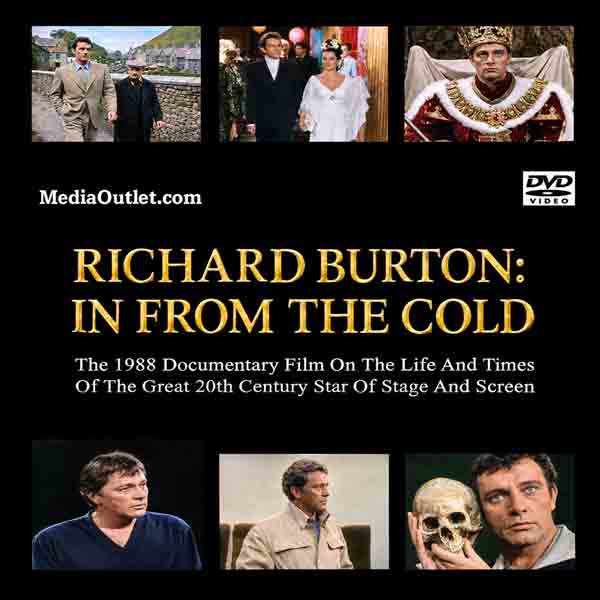
December 3, 1960: Aesthetics: Performing
Arts: Premieres: Theatre Premieres: Musical Premieres: United
States Musical Premieres: Broadway Premieres: -- The musical
Camelot debuts at the Majestic Theatre on Broadway with a cast
including Julie Andrews, Richard Burton, and Roddy McDowall, as
well as Robert Goulet in his first Broadway role. Camelot is a
musical by Alan Jay Lerner (book and lyrics) and Frederick Loewe
(music). It is based on the King Arthur legend as adapted from T.
H. White's 1958 novel The Once and Future King. The original 1960
production, directed by Moss Hart with orchestrations by Robert
Russell Bennett and Philip J. Lang, ran on Broadway for 873
performances, winning four Tony Awards and spawning several
revivals, foreign productions, and the 1967 Warner Bros. film
Camelot. The musical has become associated with the Kennedy
Administration, which is sometimes called the "Camelot Era".
On Sale @ 15% Off Discount Till Midnight PT!
https://store.earthstation1.com/richard-burton-in-from-the-cold-documentary-dvd.html
Today's
EarthStation1.com 15% Off Commemorative Memorial Title: Satchmo:
Louis Armstrong Biography + Bonus Title DVD MP4 USB Drive
Today, December 3, 2025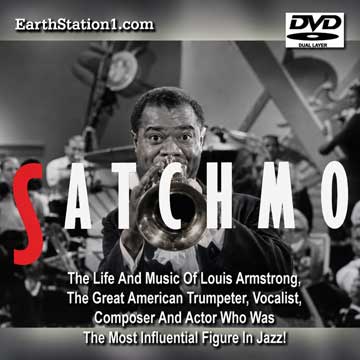
December 3-4, 1963: Aesthetics: The
Performing Arts: Music: Music History: Music Of The United States:
Recording Sessions: -- Louis Armstrong records the song "Hello
Dolly" in a New York City recording studio for Kapp Records.
Armstrong expressed no great enthusiasm for the song; the
songwriter, Jerry Herman, a canny Broadway craftsman who knew how
to write for stars who also wrote the scores for many other
popular musicals including Mame and La Cage aux Folles, said "When
a man from my publishing company called me and said, `Louis
Armstrong wants to record that,' I laughed. I thought it was the
silliest idea that I had ever heard. But I said, `Let him have a
good time. I'm delighted,' you know. And when I heard the
recording, I fell out of my chair because he turned my 1890's
valentine into one of the most famous pop songs of all time."
Kapp released "Hello Dolly" on February 15, 1964,
entering the Billboard charts at No.76, one place ahead of the
Dave Clark Five. Twelve weeks later on May 9, 1964, "Hello
Dolly" knocked The Beatles, "Can't Buy Me Love"
from the top spot, and in doing so ended fourteen straight weeks
of Beatles' No.1s. "Hello Dolly" only spent a week
there, and was knocked from the top by Mary Wells's "My Guy,"
but none of that bothered Satchmo - Louis was back and back big
time! On Sale @ 15% Off Discount Till Midnight PT!
https://store.earthstation1.com/satchmo-louis-armstrong-biography-dvd-mp4-usb-driv4.html
Today's
EarthStation1.com 15% Off Commemorative Memorial Title: Is Freedom
Academic? 1964 Berkeley Student Protests LP CD, MP3, USB
Today, December 3, 2025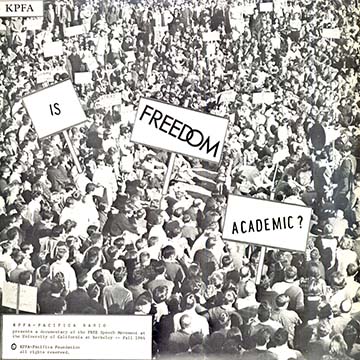
December 3, 1964: Freedom Of Speech:
Freedom Of Speech In The United States: Counterculture Of The
1960s: Student Rights: The New Left: Student Rights In Higher
Education: Student Protests: The 1960s Berkeley Protests: The Free
Speech Movement (FSM): -- Police arrest over 800 students at the
University of California, Berkeley, following their takeover and
sit-in at the administration building in protest of the UC
Regents' decision to forbid protests on UC property. The Free
Speech Movement (FSM) was a massive, long-lasting student protest
which took place during the 1964-65 academic year on the campus of
the University of California, Berkeley. The Movement was
informally under the central leadership of Berkeley graduate
student Mario Savio. Other student leaders include Jack Weinberg,
Michael Rossman, George Barton, Brian Turner, Bettina Aptheker,
Steve Weissman, Michael Teal, Art Goldberg, Jackie Goldberg, and
others. On Sale @ 15% Off Discount Till Midnight PT!
https://store.earthstation1.com/is-freedom-academic-mp3-cd-1964-berkeley-student-pro31964.html
Today's
EarthStation1.com 15% Off Commemorative Memorial Title:
Alternative Rubber Soul Beatles MP3 CD Audio Download USB Flash
Drive
Today, December 3, 2025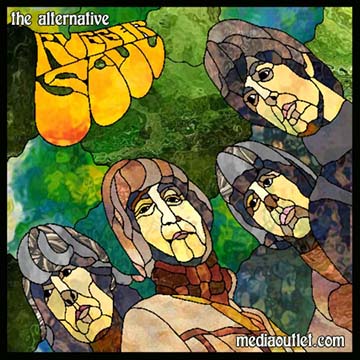
December 3, 1965: Aesthetics: The
Performing Arts: Music: Music History: The History Of Rock And
Roll (Rock & Roll, Rock-N-Roll, Rock 'N' Roll, Rock 'N Roll,
Rock N' Roll): British Rock And Roll (British Rock & Roll,
British Rock-N-Roll, British Rock 'N' Roll, British Rock 'N Roll,
British Rock N' Roll): The Swinging Sixties: Music Of The United
Kingdom: Rock And Roll (Rock & Roll, Rock-N-Roll, Rock 'N'
Roll, Rock 'N Roll, Rock N' Roll): Concerts: British Rock (Beat
Music, British Beat, Merseybeat): The Swinging Sixties: Music Of
The United Kingdom: Rock And Roll (Rock & Roll, Rock-N-Roll,
Rock 'N' Roll, Rock 'N Roll, Rock N' Roll): The British Invasion:
The Beatles: Record Releases: -- Rubber Soul, the sixth studio
album by the English rock band the Beatles in the United Kingdom,
on EMI's Parlophone label, accompanied by the non-album double
A-side single "Day Tripper" / "We Can Work It Out".
The original North American release, issued by Capitol Records,
contains ten of the fourteen songs and two tracks withheld from
the band's Help! album. Rubber Soul was met with a highly
favourable critical response and topped sales charts in Britain
and the United States for several weeks. The recording sessions
took place in London over a four-week period beginning in October
1965. For the first time in their career, the Beatles were able to
record an album free of concert, radio or film commitments. Often
referred to as a folk rock album, particularly in its Capitol
configuration, Rubber Soul incorporates a mix of pop, soul and
folk musical styles. The title derives from the colloquialism
"plastic soul" used by the Beatles to compare their
material to the African American soul artists they admired. After
A Hard Day's Night in 1964, it was the second Beatles LP to
contain only original material. The songs demonstrate the Beatles'
increasing maturity as lyricists, and in their incorporation of
brighter guitar tones and new instrumentation such as sitar,
harmonium and fuzz bass, the group striving for more expressive
sounds and arrangements for their music. The project marked a
progression in the band's treatment of the album format as an
artistic platform, an approach they continued to develop with
Revolver and Sgt. Pepper's Lonely Hearts Club Band. The four songs
omitted by Capitol, including the February 1966 single "Nowhere
Man", later appeared on the North American release Yesterday
and Today. Rubber Soul was highly influential on the Beatles'
peers, leading to a widespread focus away from singles and onto
creating albums of consistently high-quality songs. It has been
recognised by music critics as an album that opened up the
possibilities of pop music in terms of lyrical and musical scope,
and as a key work in the creation of styles such as psychedelia
and progressive rock. Two years after the start of Beatlemania,
the band were open to exploring new themes in their music through
a combination of their tiring of playing to audiences full of
screaming fans, their commercial power, a shared curiosity gained
through literature and experimentation with soft and
hallucinogenic drugs, and their interest in the potential of the
recording studio. According to Ringo Starr, Rubber Soul was the
Beatles' "departure record", written and recorded during
a period when, largely through the influence of marijuana, "We
were expanding in all areas of our lives, opening up to a lot of
different attitudes." It was the first Beatles record which
was noticeably drug-influenced; John Lennon called Rubber Soul
"the pot album". Marijuana appealed to the band's
bohemian ideal. Paul McCartney said it was a move away from
alcohol nto "more of a beatnik scene, like jazz". The
album was especially reflective of John Lennon's maturation as a
songwriter, as he was encouraged to address wider-ranging issues
than before through Dylan's example. George Harrison's outlook had
been transformed by his and Lennon's experiences with the
hallucinogenic drug LSD; he said the drug had revealed to him the
futility of the band's widespread fame by "open[ing] up this
whole other consciousness". Among its many appearances on
critics' best-album lists, Rolling Stone ranked it fifth on the
magazine's 2012 list "The 500 Greatest Albums of All Time".
In 2000, it was voted at number 34 in the third edition of Colin
Larkin's book All Time Top 1000 Albums. The album was certified 6_
platinum by the RIAA in 1997, indicating shipments of at least six
million copies in the US. In 2013, Rubber Soul was certified
platinum by the BPI for UK sales since 1994. On Sale @ 15% Off
Discount Till Midnight PT!
https://store.earthstation1.com/alternative-rubber-soul-beatles-mp3-cd-audio-download-usb-flash-driv3.html
Today's
EarthStation1.com 15% Off Commemorative Memorial Title: Bob
Dylan's KQED-TV Francisco Press Conference 12/3/65 MP4 Or DVD
Today, December 3, 2025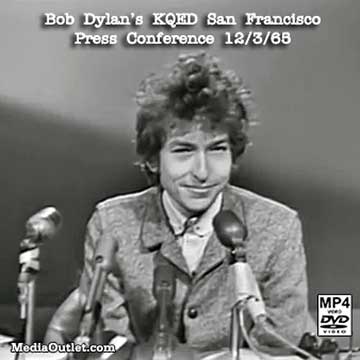
December 3, 1966: Bob Dylan's KQED
Interview: -- Bob Dylan holds a landmark press conference on a
Friday in the studios San Francisco's educational television
station KQED-TV Channel 9 (now a PBS member station). When Bob
Dylan's five concerts in the San Francisco Bay Area were scheduled
for December 1965, KQED proposed the press conference to Dylan.
Dylan accepted the proposal, and flew out a day early to make it.
He arrived early, accompanied by Robbie Robertson and several
other members of his band (which ultimately became known as "The
Band"), drank tea in the KQED office, and insisted e was
ready to talk about "anything you want to talk about."
His only request was that he be able to leave at 3 p.m. so that he
could rehearse in the Berkeley Community Theater where he was to
sing that night. On this same day, two seminal albums were
released: The Who's "My Generation" in the UK, and The
Beatles' "Rubber Soul" worldwide. At the press
conference there were TV news crews of all the local stations,
reporters for three metropolitan dailies (their stories were
subsequently compared to the broadcast of the interview by a
University of California journalism department class),
representatives of several high school papers, and personal
friends of Dylan including poet Allen Ginsberg, impresario Bill
Graham and comedian Larry Hankin, all of whom are seen and heard
during the press conference. The questions ranged from standard
journalistic questions to teen fan club inquiries to "in-group"
personal interrogatories and put ons, to questions by those who
really had listened to Dylan's songs. He sat on a raised platform
facing the cameras and the reporters, and answered questions
before a bank of four microphones, all while chain smoking
cigarettes and swinging his leg back and forth. At one point he
held up a poster for a Friday, December 10th benefit for The San
Francisco Mime Troupe (the first rock dance at Bill Graham's
Fillmore Auditorium, one of the first public dances to feature the
Jefferson Airplane, and featuring The Great Society (whose singer
Grace Slick soon joined The Jefferson Airplane). At the conclusion
of the press conference, he chatted with friends for a bit, jumped
into a car and went back to Berkeley for the rehearsal. He cut the
rehearsal short so as to get to his hotel and watch KQED's
broadcast of the press conference that night. It was rebroadcast
the following week. On Sale @ 15% Off Discount Till Midnight PT!
https://store.earthstation1.com/bob-dylan-kqed-tv-francisco-press-conference-12-3-65-mp4-or-dvd.html
Today's
EarthStation1.com 15% Off Commemorative Memorial Title: Pioneers
Of Surgery Documentary TV Series DVD, MP4 Download, USB Drive
Today, December 3, 2025
December 3, 1967: Medicine: The History
Of Medicine: Surgery: The History Of Surgery: Cardiac Surgery: The
History Of Cardiac Surgery: The First Human-To-Human Heart
Transplant: -- In the early morning hours of a Sunday at Groote
Schuur Hospital in Cape Town, South Africa, a transplant team
headed by Christiaan Barnard carries out the first heart
transplant on a human. Louis Washkansky, a 54-year-old grocer who
was suffering from diabetes and incurable heart disease, was the
patient. Barnard was assisted by his brother Marius Barnard, as
well as a team of thirty staff members. The operation lasted
approximately five hours. Barnard stated to Washkansky and his
wife Ann Washkansky that the transplant had an 80% chance of
success. This has been criticised by the ethicists Peter Singer
and Helga Kuhse as making claims for chances of success to the
patient and family which were "unfounded" and
"misleading". Barnard later wrote, "For a dying man
it is not a difficult decision because he knows he is at the end.
If a lion chases you to the bank of a river filled with
crocodiles, you will leap into the water, convinced you have a
chance to swim to the other side." The donor heart came from
a young woman, Denise Darvall, who had been rendered brain dead in
an accident the day prior on December 2 1967, while crossing a
street in Cape Town. On examination at Groote Schuur hospital,
Darvall had two serious fractures in her skull, with no electrical
activity in her brain detected, and no sign of pain when ice water
was poured into her ear.] Coert Venter and Bertie Bosman requested
permission from Darvall's father for Denise's heart to be used in
the transplant attempt. The afternoon before his first transplant,
Barnard dozed at his home while listening to music. When he awoke,
he decided to modify Shumway and Lower's technique. Instead of
cutting straight across the back of the atrial chambers of the
donor heart, he would avoid damage to the septum and instead cut
two small holes for the venae cavae and pulmonary veins. Prior to
the transplant, rather than wait for Darvall's heart to stop
beating, at his brother Marius Barnard's urging, Christiaan had
injected potassium into her heart to paralyse it and render her
technically dead by the whole-body standard. Twenty years later,
Marius Barnard recounted, "Chris stood there for a few
moments, watching, then stood back and said, 'It works.'"
Washkansky survived the operation and lived for 18 days, having
succumbed to pneumonia as he was taking immunosuppressive drugs.
On Sale @ 15% Off Discount Till Midnight PT!
https://store.earthstation1.com/pioneers-of-surgery-dvd-set-4-episode-tv-series-2-dis42.html
Today's
EarthStation1.com 15% Off Commemorative Memorial Title: The Golden
Age Of Rock 'N' Roll DVD, MP4 Video Download, Flash Drive
Today, December 3, 2025
December 3, 1968: Aesthetics: Performing
Arts: Premieres: Television Premieres: United States Television
Premieres: Music Television: Elvis Presley: -- Elvis Presley's
"Singer Presents ... Elvis", commonly referred to as the
"The '68 Comeback Special", airs on the American
television network NBC at 9 PM Eastern Time. It marked Presley's
return to live performance after a seven-year period during which
he focused on his film appearances. The concert was initially
planned as a Christmas special by the network and Presley's
manager, Colonel Tom Parker. Producer Bob Finkel hired director
Steve Binder, who, rather than creating a Christmas special,
created a concert that would reflect the musical trends of the
time and appeal to a younger audience. Filming took place in June
1968 at NBC Studios in Burbank, California. The special included a
sit-down session that showcased Presley in an informal setting,
surrounded by fans and a small band. The special received positive
reviews and topped the Nielsen television ratings for the week in
which it aired. It became the most-watched show of the television
season, earning 42% of the television audience. Later known as the
Comeback Special, it relaunched Presley's singing career. On Sale
@ 15% Off Discount Till Midnight PT!
https://store.earthstation1.com/the-golden-age-of-rock-39n39-roll-dvd-complete-tv-series-5-39395.html
Today's
EarthStation1.com 15% Off Commemorative Memorial Title: Outer
Space Films 8 Project Voyager Pioneer Mariner DVD, Download, USB
Today, December 3, 2025
December 3, 1973: The History Of
Rocketry: The History Of Spaceflight: The Aftermath Of World War
II: The Cold War: The Space Age: The Space Race: The Discovery And
Exploration Of The Solar System: Space Probes: Interplanetary
Space Probes: Pioneer Program: Pioneer 10: (Pioneer F): -- Pioneer
10 sends back the first close-up images of Jupiter. Pioneer 10
(originally designated Pioneer F) is an American space probe,
launched in 1972 and weighing 258 kilograms (569 pounds), that
completed the first mission to the planet Jupiter. Thereafter,
Pioneer 10 became the first of five artificial objects to achieve
the escape velocity that will allow them to leave the Solar
System. This space exploration project was conducted by the NASA
Ames Research Center in California, and the space probe was
manufactured by TRW Inc. It was launched on March 2, 1972, by an
Atlas-Centaur expendable vehicle from Cape Canaveral, Florida.
Between July 15, 1972, and February 15, 1973, it became the first
spacecraft to traverse the asteroid belt. Photography of Jupiter
began November 6, 1973, at a range of 25,000,000 kilometers
(16,000,000 mi), and a total of about 500 images were transmitted.
The closest approach to the planet was on December 4, 1973, at a
range of 132,252 kilometers (82,178 mi). During the mission, the
on-board instruments were used to study the asteroid belt, the
environment around Jupiter, the solar wind, cosmic rays, and
eventually the far reaches of the Solar System and heliosphere.
Radio communications were lost with Pioneer 10 on January 23,
2003, because of the loss of electric power for its radio
transmitter, with the probe at a distance of 12 billion kilometers
(80 AU) from Earth. On Sale @ 15% Off Discount Till Midnight PT!
https://store.earthstation1.com/outer-space-films-8-space-probe-projects-voyager-pioneer-mercury-dv8.html
Today's
EarthStation1.com 15% Off Commemorative Memorial Title: America
Held Hostage: As It Happened The Iran Hostage Crisis MP4 DVD
Today, December 3, 2025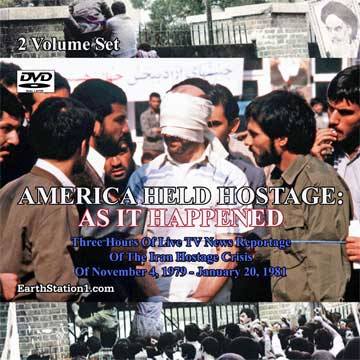
December 3, 1979: The Aftermath Of World
War II: The Cold War: The Cold War (1962-1979): The Iranian
Revolution: Aftermath Of The Iranian Revolution: -- Ayatollah
Ruhollah Khomeini becomes the first Supreme Leader of Iran.
Ruhollah Khomeini (Romanized: Ruhallah Khumayni), Iranian
political and religious leader who served as the first supreme
leader of Iran from 1979 until his death (May 17, 1900 - June 3,
1989) was the founder of the Islamic Republic of Iran and the
leader of the 1979 Iranian Revolution, which saw the overthrow of
Shah Mohammad Reza Pahlavi and the end of the Persian monarchy.
Following the revolution, Khomeini became the country's first
supreme leader, a position created in the constitution of the
Islamic Republic as the highest-ranking political and religious
authority of the nation, which he held until his death. Most of
his period in power was taken up by the Iran-Iraq War of
1980-1988. He was succeeded by Ali Khamenei on June 4, 1989. The
Supreme Leader of Iran (Persian: Romanized: Rahbar-E Iran) is the
head of state of the Islamic Republic of Iran. The Supreme Leader
directs the executive system and judicial system of the Islamic
theocratic government and is the Commander-In-Chief of the Iranian
Armed Forces. The Supreme Leader is the highest-ranking political
and religious authority of Iran. The armed forces, judiciary,
state television, and other key government organisations such as
Guardian Council and Expediency Discernment Council are subject to
the Supreme Leader. According to the constitution, the Supreme
Leader delineates the general policies of the Islamic Republic
(article 110), supervising the legislature, the judiciary, and the
executive branches (article 57). The current lifetime
officeholder, Ali Khamenei, has issued decrees and made the final
decisions on the economy, the environment, foreign policy,
education, national planning, and other aspects of governance in
Iran. Khamenei also makes the final decisions on the amount of
transparency in elections, and has dismissed and reinstated
presidential cabinet appointees. The Supreme Leader is legally
considered "inviolable", with Iranians being routinely
punished for questioning or insulting him. The office was
established by the Constitution of Iran in December 1979, pursuant
to Ayatollah Ruhollah Khomeini's concept of the Guardianship of
the Islamic Jurist, and is a lifetime appointment. In its history,
the Islamic Republic of Iran only has had two Supreme Leaders:
Khomeini, who held the position from 1979 until his death in 1989
and Ali Khamenei, who has held the position for 30+ years since
Khomeini's death. On Sale @ 15% Off Discount Till Midnight PT!
https://store.earthstation1.com/america-held-hostage-as-it-happened-the-iran-hostage-crisis-mp4-dv4.html
Today's
EarthStation1.com #OnThisDay Commemorative Memorial Title: TV
Commercials: The Classics Vol. 8 DVD, MP4 Download, USB Flash
Drive
Today, December 3, 2025 December 3: National Green Bean Casserole
Day: -- Celebrates the dish and its interesting origins. The
holidays are going to be knocking on our doors soon, and there's
no harm in getting our preparations underway from today onwards.
Green bean casserole is enjoyed by many all over America for its
few ingredients and simplistic recipe that does not require too
much time and effort. Two of the main ingredients include cream of
mushroom soup and, of course, green beans. The two are either
mixed together or layered on top of each other. The smooth and
creamy texture is complemented with the extra crunchiness of
french fried onions sprinkled over the top and voila, you have a
filling and nutritious dish. The recipe was such a gamechanger on
the American food scene that its inventor, Dorcas Lillian Bates
Reilly, features in the Hall of Fame alongside the likes of Thomas
Edison and Muhammad Ali. National Green Bean Casserole Day was
created as a holiday by Jace Shoemaker-Galloway. She is credited
with covering many unique and wacky holidays in her writing career
that spans from Yahoo, to Planet Save, to Energy Boom and many
more. Having researched all such holidays, Shoemaker-Galloway
started realizing the fun and merriment that unique holidays tend
to bring. Out of the many holiday ventures the writer brought to
life, one of the most prominent and celebrated was National Green
Bean Casserole Day. This day pays homage to the classic holiday
dish that is enjoyed by around 20 million Americans worldwide.
Reports state that around 50% of all green bean casserole recipes
are made between the period of November to January, which is when
the holidays are in full swing. So, how did this dish come into
being? It was created back in 1955 in the Home Economics
Department of Campbell Soup Company. At the time, Dorcas Reilly,
the main inventor of the dish, was working as a manager and recipe
creator for the company. The goal was to create something using
ingredients that would be readily available in an average American
kitchen. Reilly and her team selected five ingredients and created
something in 10 minutes. The world was still reeling from the
effects of WW2, and easy-to-make dishes were all the rage.
Initially, the dish was named the 'Green Bean Bake'. While the
recipe was a great way to satisfy those hunger pangs in a few
minutes, it did not take off until the 1960s when the Campbell
Soup Company started putting the recipe on their soup cans. From
then on, green bean casserole became a staple in Thanksgiving
spreads. Reilly also became known as the "grandmother of the
green bean casserole."
https://store.earthstation1.com/tv-commercials-the-classics-vol-8-dv8.html
Today's
EarthStation1.com #OnThisDay Commemorative Memorial Title: Songs
Of Protest And Conscience Played In The USA DVD, MP4, USB Drive
Today, December 3, 2025December 3: National Roof Over Your Head
Day: -- Following closely after Thanksgiving (another day to be
thankful), National Roof Over Your Head Day asks us to give thanks
for what we have, beginning with the roof over our heads,
particularly because many other people lack this basic necessity.
This day is a lovely reminder to be content with our lot and avoid
worrying about things we do not yet have. Whereas we are still
tracing the origins of this day, the origin of homelessness in
America, on the other hand, is well-documented. In colonial
America, people without a roof over their heads were labeled
vagrants (around the 1600s) and 'sturdy beggars' (in the mid-18th
century). Most colonial towns - like Baltimore and Philadelphia -
had a significant number of such people. This situation was likely
caused by King Philip's War (also called the First Indian War)
against the colonial people in 1676, which drove many people out
of their homes, forcing them to seek shelter elsewhere. Major
cities were not as populated; only about 7% of Americans lived in
these places. The industrial revolution changed this, bringing a
steady stream of workers to urban centers. By the 1850s, major
cities had reported a larger number of vagrants than ever before,
and the only shelter system for them was the lodging rooms located
inside police stations. Over the years, the people seeking shelter
grew to include different races, nationalities, and age groups,
too. The solutions for such a situation have also changed over the
years: In the early 20th century, people believed jobs were the
answer; Now, creating affordable housing is considered the remedy.
Even today, there are as many as 100 million people without a roof
over their heads all around the U.S., and this is likely the
reason this Day was created. Many states have come up with
creative solutions to alleviate this problem and continue to
devise and roll out strategies to enable shelter for every person
in America. (Sell Songs Of Protest And Conscience , Suburbia)
https://store.earthstation1.com/songs-of-protest-and-conscience-played-in-the-usa-dvd-mp4-us4.html
Today's
EarthStation1.com #OnThisDay Commemorative Memorial Title: NBC
University Theater Of The Air Literature Radio Series MP3 DVD USB
Today, December 3, 2025December 3, 1894: #DOTD: #RIP: Robert
Louis Stevenson, Scottish novelist, poet, travel writer and
essayist most noted for Treasure Island, Kidnapped, Strange Case
of Dr Jekyll and Mr Hyde, and A Child's Garden of Verses (b.
November 13, 1850) #dies in his island home in 1894 in the village
of Vailima, Samoa at the age of 44 of an apparent cerebral
haemorrhage. Stevenson was talking to his wife and straining to
open a bottle of wine when he suddenly exclaimed, "What's
that?", asked his wife "does my face look strange?",
and collapsed. He died within a few hours. The Samoans insisted on
surrounding his body with a watch-guard during the night and on
bearing him on their shoulders to nearby Mount Vaea, where they
buried him on a spot overlooking the sea on land donated by
British Acting Vice Consul Thomas Trood. Stevenson had always
wanted his Requiem inscribed on his tomb: ========= "Under
the wide and starry sky, Dig the grave and let me lie. Glad did I
live and gladly die, And I laid me down with a will. This be the
verse you grave for me: Here he lies where he longed to be; Home
is the sailor, home from sea, And the hunter home from the hill."
========= Stevenson was loved by the Samoans, and his tombstone
epigraph was translated to a Samoan song of grief. Born and
educated in Edinburgh, Robert Lewis Balfour Stevenson suffered
from serious bronchial trouble for much of his life, but continued
to write prolifically and travel widely in defiance of his poor
health. As a young man, he mixed in London literary circles,
receiving encouragement from Andrew Lang, Edmund Gosse, Leslie
Stephen and W. E. Henley, the last of whom may have provided the
model for Long John Silver in Treasure Island. In 1890, he settled
in Samoa where, alarmed at European and American encroachment upon
the South Sea islands, his writing turned away from romance and
adventure toward a darker realism. A celebrity in his lifetime,
Stevenson's critical reputation has fluctuated since his death,
though today his works are held in general acclaim. In 2018 he was
ranked, just behind Charles Dickens, as the 26th-most-translated
author in the world.
https://store.earthstation1.com/nbc-university-theater-of-the-air-otr-mp3-dv3.html
Today's
EarthStation1.com #OnThisDay Commemorative Memorial Title:
Montparnasse Revisited: The Genius That Was Paris DVD, MP4, USB
Drive
Today, December 3, 2025December 3, 1919: #DOTD: #RIP:
Pierre-Auguste Renoir, French painter and sculptor who was a
leading painter in the development of the Impressionist style (b.
February 25, 1841) #dies at Cagnes-sur-Mer, France at the age of
78. He is buried at Essoyes Cimetiere in Essoyes, in the Aube
department in north-central France; Renoir had a house in there,
and the village, which was the hometown of both his wife and model
Aline, and his model and governess of his children, Aline's cousin
Gabrielle Renard, is represented in many of his paintings.
Pierre-Auguste Renoir was born in the city and commune of Limoges,
the prefecture of the Haute-Vienne department in west-central
France. His father, Leonard Renoir, was a tailor of modest means,
so, in 1844, Renoir's family moved to Paris in search of more
favorable prospects. The location of their home, in rue
d'Argenteuil in central Paris, placed Renoir in proximity to the
Louvre. As a celebrator of beauty and especially feminine
sensuality, art historian Herbert Read wrote in his 1931 book "The
Meaning of Art" that "Renoir is the final representative
of a tradition which runs directly from Rubens to Watteau."
He was the father of actor Pierre Renoir (1885-1952), filmmaker
Jean Renoir (1894-1979) and ceramic artist Claude Renoir
(1901-1969). He was the grandfather of the filmmaker Claude Renoir
(1913-1993), son of Pierre.
https://store.earthstation1.com/montparnasse-revisted-the-genius-that-was-paris-3-dvd3.html
Today's
EarthStation1.com #OnThisDay Commemorative Memorial Title: Bob
Marley And The Wailers (1986) Documentary MP4 Video Download DVD
Today, December 3, 2025December 3, 1976: Aesthetics: The
Performing Arts: Music: Music History: Music Of Jamaica: Reggae
Music: The Attempted Assassination Of Bob Marley: -- At 8:30pm, an
assassination attempt is made on Bob Marley by seven men armed
with guns in Marley's house at 56 Hope Road; yet two days later,
he plays The Smile Jamaica Concert, a free concert organised by
the Jamaican Prime Minister Michael Manley of the democratic
socialist People's National Party (PNP) in an attempt to ease
tension between two warring political groups, at National Heroes
Park, Kingston, Jamaica. According to Don Taylor, the gunmen were
later tried and executed by a "ghetto court" at which he
and Marley were present; according to Taylor, before one of the
shooters was killed, he claimed the job was done for the CIA in
exchange for cocaine and guns. Marley's wife, Rita, was shot in
the head in her car in the driveway. The gunmen shot Marley in the
chest and arm. His manager, Don Taylor, was shot in the legs and
torso. Band employee, Louis Griffiths took a bullet to his torso
as well. Astonishingly, there were no fatalities. Bob Marley told
concert chairman Trevor Philips that Edward Seaga, the leader of
the right-wing Jamaican Labour Party (JLP) - Manley's most
powerful opponent - was alleged to have ordered his bodyguard,
Lester "Jim Brown" Coke, to be present during the
shooting. Nancy Burke, Marley's neighbour and friend, recalled
hearing Wailers percussionist Alvin Patterson, say "Is Seaga
men! Dem come fi kill Bob!" After the shooting, numerous
reports indicated that the gunmen returned to Tivoli Gardens, a
neighbourhood loyal to the JLP and home to the notorious Shower
Posse. Timothy White, the author of Catch a Fire, claimed that
information he received from JLP and PNP officials as well as US
law enforcement officials led him to believe that Carl Byah
"Mitchell", a JLP gunman, was contracted by the CIA to
organize the Marley shooting and that Lester Coke, aka Jim Brown,
led the charge on Hope Road. After the shooting, American
ambassador to Jamaica Sumner Gerard wrote a cable he sent from the
American embassy entitled "Reggae Star Shot: Motive probably
political". He wrote "Some see the incident as an
attempt by JLP gunmen to halt the concert, which would feature the
"politically progressive" music of Marley and other
reggae stars. Others see it as a deep-laid plot to create a
progressive, youthful Jamaican martyr to the benefit of the PNP.
Those holding the latter view note that the four persons shot,
three of them including Marley, only suffered minor wounds."
When Marley was asked why he chose to perform after the
assassination attempt, Marley replied "The people who are
trying to make this world worse aren't taking a day off. How can
I?" Though the concert was billed as headlined by Bob Marley
& The Wailers, the members of the group Zap Pow played as Bob
Marley's backup band, and played before a festival crowd of 80,000
while members of The Wailers were still missing or in hiding.
Politicians from across the political spectrum hoped to capitalize
on Marley's support. While Marley remained neutral, many viewed
him as tacitly supporting the prime minister Michael Manley and
his PNP.
https://store.earthstation1.com/bob-marley-and-the-wailers-dvd-1986-documen1986.html
Today's
EarthStation1.com #OnThisDay Commemorative Memorial Title:
Presidential Campaign TV Ads 1952-1992 MP4 Video Download 4 DVD
Set
Today, December 3, 2025December 3, 2017: #DOTD: #RIP: John B.
Anderson, American soldier, lawyer, politician, United States
Congressman and 1980 US presidential candidate (b. February 15,
1922) #dies in Washington D.C. at the age of 95. He is buried at
Arlington National Cemetery in Arlington, Virginia. John B.
Anderson was born John Bayard Anderson in Rockford, Illinois. As a
member of the Republican Party, he represented Illinois's 16th
congressional district from 1961 through 1981. In 1980, he ran an
independent campaign for president, taking 6.6% of the popular
vote. Born in Rockford, Illinois, Anderson practiced law after
serving in the Army during World War II. After a stint in the
United States Foreign Service, he won election as the State's
Attorney for Winnebago County, Illinois. He won election to the
House of Representatives in 1960 in a strongly Republican
district. Initially one of the most conservative members of the
House, Anderson's views moderated during the 1960s, particularly
regarding social issues. He became Chairman of the House
Republican Conference in 1969 and remained in that position until
1979. He strongly criticized the Vietnam War as well as President
Richard Nixon's actions during the Watergate scandal. Anderson
entered the 1980 Republican presidential primaries, introducing
his signature campaign proposal of raising the gas tax while
cutting social security taxes. He established himself as a
contender for the nomination in the early primaries, but
eventually dropped out of the Republican race, choosing to pursue
an independent campaign for president. In the election, he
finished third behind Republican nominee Ronald Reagan and
Democratic President Jimmy Carter. He won support among
Rockefeller Republicans, independents, liberal intellectuals, and
college students. After the election, he resumed his legal career
and helped found FairVote, an organization that advocates
electoral reforms such as instant-runoff voting. He also won a
lawsuit against the state of Ohio, Anderson v. Celebrezze, in
which the Supreme Court struck down early filing deadlines for
independent candidates. Anderson served as a visiting professor at
numerous universities and was on the boards of several
organizations. He endorsed Ralph Nader in 2000 and helped found
the Justice Party in 2012.
https://store.earthstation1.com/presidential-campaign-tv-ads-19521984-dvds-2-dual-la195219842.html
Today's
EarthStation1.com #OnThisDay Commemorative Memorial Title: The
Soviet-Afghan War DVD, MP4 Video Download, USB Flash Drive
Today, December 3, 2025December 3, 1996: #DOTD: Babrak Karmal,
Afghan politician who was installed as President of Afghanistan by
the Soviet Union when they intervened in 1979 (b. January 6, 1929)
#dies from liver cancer in Moscow, Russia, aged 67. He is buried
in Heyratan Common Graveyard in Heyratan, Afghanistan. Babrak
Karmal was born Sultan Hussein in Kamari, Kabul Province, Kingdom
of Afghanistan, the son of Muhammad Hussein Hashem, a Major
General in the Afghan Army and former governor of the province of
Paktia, and was the second of five siblings. Educated at Kabul
University, became one of the leading members of the People's
Democratic Party of Afghanistan (PDPA) when it was formed, having
been introduced to Marxism by Mir Akbar Khyber during his
imprisonment for activities deemed too radical by the government.
He eventually became the leader of the Parcham faction when the
PDPA split in 1967, with their ideological nemesis being the Khalq
faction. Under Karmal's leadership, the Parchamite PDPA
participated in Mohammad Daoud Khan's rise to power in 1973, and
his subsequent regime. While relations were good at the beginning,
Daoud began a major purge of leftist influence in the mid-1970s.
This in turn led to the reformation of the PDPA in 1977, and
Karmal played a major role in the 1978 Saur Revolution when the
PDPA took power, though in later years he denounced it. Karmal was
appointed Deputy Chairman of the Revolutionary Council, synonymous
with vice head of state, in the communist government. The
Parchamite faction found itself under significant pressure by the
Khalqists soon after taking power. In June 1978, a PDPA Central
Committee meeting voted in favor of giving the Khalqist faction
exclusive control over PDPA policy. This decision was followed by
a failed Parchamite coup, after which Hafizullah Amin, a Khalqist,
initiated a purge against the Parchamites. Karmal survived this
purge but was exiled to Prague and eventually dismissed from his
post. Instead of returning to Kabul, he feared for his life and
lived with his family in the forests protected by the Czechoslovak
secret police StB. The Afghan secret police KHAD had allegedly
sent members to Czechoslovakia to assassinate Karmal. In late 1979
he was brought to Moscow by the KGB and eventually, in December
1979, the Soviet Union intervened in Afghanistan (with the consent
of Amin's government) to stabilize the country. The Soviet troops
staged a coup and assassinated Amin. On December 27, 1979,
Hafizullah Amin, Afghan People's Democratic Party General
Secretary and 2nd President of Afghanistan, was assassinated by
the Soviets as part of Operation Storm-333 (Russian: Shtorm-333),
a covert operation in which Soviet special forces stormed the
Tajbeg Palace in Afghanistan with the deliberate intent of
assassining Amin. There are various accounts of how Amin died, and
the exact details have never been confirmed, but it is believed he
was killed either by a deliberate attack or died by a "random
burst of fire", having ruled for slightly longer than three
months. Tajbeg Palace was guarded by Afghan National Army. In the
ensuing battle, Afghan armed forces suffered major losses. 30
Afghan palace guards and over 300 army guards were killed while
150 were captured. Amin's 11-year-old son died from shrapnel
wounds. A total of 1,700 Afghan soldiers surrendered to Soviet
troops and were taken as prisoners. The Soviets installed Babrak
Karmal as Amin's successor. Several other government buildings
were seized during the operation, including the Ministry of
Interior building, the Internal Security (KHAD) building, and the
General Staff building (Darul Aman Palace). Alpha Group veterans
call this operation one of the most successful in the group's
history. Declassified Russian documents show that the Soviet
leadership believed that Hafizullah Amin had secret contacts with
the US embassy and was probably a US agent. However, this
assumption was later proven to be false. Amin was born in Paghman
and educated at Kabul University, after which he started his
career as a teacher. After a few years in that occupation, he went
to the United States to study. He would visit the United States a
second time before moving permanently to Afghanistan, and starting
his career in radical politics. He ran as a candidate in the 1965
parliamentary election but failed to secure a seat. Amin was the
only Khalqist elected to parliament in the 1969 parliamentary
election, thus increasing his standing within the party. He was
one of the leading organizers of the Saur Revolution which
overthrew the government of Mohammad Daoud Khan. In 1979 he named
himself as president, prime minister, and chairman of the Khalq
wing. He has been described as "ruthless" and a "radical
Marxist". Amin's short-lived presidency was marked by
controversies from beginning to end. He came to power by disposing
of his predecessor Nur Muhammad Taraki and later ordering his
death. Amin made attempts to win support from those who revolted
against the communist regime which had begun under Taraki, but his
government was unable to solve this problem. Many Afghans held
Amin responsible for the regime's harshest measures, such as
ordering thousands of executions. Thousands of people disappeared
without trace during his time in office. The Soviet Union, which
was dissatisfied with Amin, intervened in Afghanistan while
invoking the Twenty-Year Treaty of Friendship between Afghanistan
and the Soviet Union. Karmal remained in office until 1981, when
he was succeeded by Sultan Ali Keshtmand. Throughout his term,
Karmal worked to establish a support base for the PDPA by
introducing several reforms. Among these were the "Fundamental
Principles of the Democratic Republic of Afghanistan",
introducing a general amnesty for those people imprisoned during
Nur Mohammad Taraki's and Amin's rule. He also replaced the red
Khalqist flag with a more traditional one. These policies failed
to increase the PDPA's legitimacy in the eyes of the Afghan people
and the mujahideen rebels. Karmal had always been highly critical
of his Khalqist predecessors Nur Muhammad Taraki and Amin's
ultra-left radicalism. These policy failures, and the stalemate
that ensued after the Soviet intervention, led the Soviet
leadership to become highly critical of Karmal's leadership. Under
Mikhail Gorbachev, the Soviet Union deposed Karmal in 1986 and
replaced him with Mohammad Najibullah. Following his loss of
power, he was again exiled, this time to Moscow. It was Anahita
Ratebzad who persuaded Najibullah to allow Babrak Karmal to return
to Afghanistan in 1991, where Karmal became an associate of Abdul
Rashid Dostum and possibly helped remove the Najibullah government
from power in 1992. He eventually left Afghanistan again for
Moscow, and died not long after.
https://store.earthstation1.com/the-sovietafghan-war-dvd-mp4-usb-driv4.html
Today's
EarthStation1.com #OnThisDay Commemorative Memorial Title: Waging
Peace 1989 New World Order Realities Possibilities DVD MP4 USB
Today, December 3, 2025December 3, 1989: United States-Soviet
Union Relations (US-Soviet Relations, US-USSR Relations): United
States-Soviet Union Diplomatic Conferences (US-Soviet Diplomatic
Conferences, US-USSR Diplomatic Conferences): The Aftermath Of
World War II: The Cold War: The Malta Summit: -- In a meeting off
the coast of Malta, U.S. President George H. W. Bush and Soviet
leader Mikhail Gorbachev release statements declaring that the
Cold War between NATO and the Warsaw Pact was at an end; whether
it was truly ended is a matter of debate. Held just a few weeks
after the fall of the Berlin Wall, The Malta Summit followed a
meeting that included Ronald Reagan in New York in December 1988.
News reports of the time referred to the Malta Summit as one of
the most important since World War II, when British prime minister
Winston Churchill, Soviet General Secretary Joseph Stalin and US
President Franklin D. Roosevelt agreed on a post-war plan for
Europe at the Yalta Conference.
https://store.earthstation1.com/waging-peace-1989-new-world-order-realities-possibilities-dvd-mp19894.html
Today's
EarthStation1.com #OnThisDay Commemorative Memorial Title: A
Strong Man In Egypt: Giovanni Belzoni DVD, Video Download, USB
Drive
Today, December 3, 2025December 3, 1823: #DOTD: #RIP: Giovanni
Belzoni, also known as The Great Belzoni, prolific Italian
explorer and pioneer archaeologist of Egyptian antiquities (d.
November 5, 1778) #dies aged 45 in a village called Gwato (Gwata)
in the Commune Of Djakotomey, Kouffo, Kingdom Of Benin (modern
Pya, Kara, Togo), where he is buried; according to the celebrated
traveller Richard Francis Burton, Belzoni was murdered and robbed.
Born Giovanni Battista Belzoni in Padua, Italy, he is known for
his removal to England of the seven-ton bust of Ramesses II, the
clearing of sand from the entrance of the great temple at Abu
Simbel, the discovery and documentation of the tomb of Seti I
(still sometimes known as "Belzoni's Tomb"), including
the Sarcophagus of Seti I, and the first to penetrate into the
Pyramid of Khafre, the second pyramid of the Giza Pyramid Complex.
https://store.earthstation1.com/footsteps-a-strong-man-in-egypt-archeologist-giovanni-belzoni.html
Today's
EarthStation1.com #OnThisDay Commemorative Memorial Title: WWII
Films: The Asia-Pacific War DVD, Video Download, USB Flash Drive
Today, December 3, 2025December 3, 1942: World War II: The
Pacific War (The Asia-Pacific War, The Asiatic-Pacific Theater,
The Pacific Theater Of World War II): The Pacific Ocean Theater Of
World War II: The South West Pacific Area (SWPA): Operation
Cartwheel: The Solomon Islands Campaign: The New Georgia Campaign
(The New Georgia Islands Campaign): -- Munda airstrip on New
Georgia Island is discovered by American planes. This Japanese
airstrip, located on the site of today's Munda Airport, was the
main objective of the June 30, 1943 American assault on the
island, which had been occupied by the Empire Of Japan since the
early stages of the war. The airstrip was used to attack American
forces and to support their own forces fighting during the Battle
Of Guadalcanal. A Japanese convoy put into Munda Point on November
24, 1942, and started construction under careful concealment from
the air by means of rows of coconut palms suspended by cable.
Despite this camoflague, the airstrip was discovered by American
planes on December 3, and the first airstrikes were delivered by
B-17 Flying Fortress bombers on December 9. After American
However, the Japanese were able to continue to use Munda, despite
regular bombardment from both air and sea, and the Allies launched
Operation Cartwheel in order to drive the Japanese out of the
Solomons and ultimately eliminate the large Japanese base at
Rabaul. The New Georgia Campaign was launched with landings on New
Georgia and nearby islands on June 30, 1943, when mainly American
but also Pacific Islander troops conducted the Landings On Rendova
and several other amphibious operations throughout the New Georgia
Group. The Allied forces spent July 1943 conducting the Drive On
Munda Point, shelling and bombing Japanese forces in and around
Munda Airfield, fighting off a large Japanese counterattack, and
eventually closing in on Munda overland, capturing it on August
4-5 during the Battle Of Munda Point. The heavy fighting left
thousands dead on both sides and many more wounded. New Georgia
was secured by American forces on August 23, after weeks of
difficult and bloody fighting that continued on some nearby
islands until October 1943. Donald Gilbert Kennedy was a
Coastwatcher stationed at Seghe (Segi) on New Georgia during the
Solomon Islands Campaign. For his services as a Coastwatcher, he
was awarded the Distinguished Service Order (DSO) (UK), and the
Navy Cross (U.S.). Since 1978, the island has been part of the
independent state of Solomon Islands.
https://store.earthstation1.com/wwii-films-the-asiapacific-conflict-dvd.html
Today's
EarthStation1.com #OnThisDay Commemorative Memorial Title: The
March Of Time Newsreel Set 1933-46 All 3 TV Series DVD, MP4, USB
Today, December 3, 2025December 3, 1980: #DOTD: Oswald Mosley,
English politician, orator, anti-Semite and fascist leader who
rose to fame in the 1920s as a Member of Parliament and later in
the 1930s, having become disillusioned with mainstream politics,
as the leader of the British Union of Fascists (BUF) (b. November
16, 1896) #dies at his home in Orsay outside Paris, France at the
age of 84. His body was cremated in a ceremony held at the Pere
Lachaise Cemetery, and his ashes were scattered on the garden pond
at Orsay. Born Oswald Ernald Mosley at 47 Hill Street, Mayfair,
Westminster, he was the eldest of the three sons of Sir Oswald
Mosley, 5th Baronet (1873-1928), and Katharine Maud
Edwards-Heathcote (1874-1950), daughter of Captain Justinian H.
Edwards-Heathcote of Apedale Hall, Staffordshire. Sir Oswald
Ernald Mosley, 6th Baronet, had not been knighted, but he was the
sixth baronet of the Mosley baronets, one of three baronetcies
created for members of the Mosley family, with a title that had
been in his family for more than a century at his father's death
on 21 September 1928. After military service during the First
World War, Mosley was one of the youngest Members of Parliament,
representing Harrow from 1918 to 1924, first as a Conservative,
then an independent, before joining the Labour Party. At the 1924
General Election he stood in Birmingham Ladywood against future
Prime Minister Neville Chamberlain, coming within 100 votes of
beating him. Mosley returned to Parliament as Labour MP for
Smethwick at a by-election in 1926 and served as Chancellor of the
Duchy of Lancaster in the Labour Government of 1929-31. He was
considered a potential Labour Prime Minister but resigned due to
discord with the Government's unemployment policies. He chose not
to defend his Smethwick constituency at the 1931 general election,
instead unsuccessfully standing in Stoke-on-Trent. Mosley's New
Party became the British Union of Fascists (BUF) in 1932. After
his election failure in 1931, Mosley went on a study tour of the
"new movements" of Italy's Benito Mussolini and other
fascists, and returned convinced that it was the way forward for
Britain. He was determined to unite the existing fascist movements
and created the British Union of Fascists (BUF) in 1932. The BUF
was protectionist, strongly anti-communist and nationalistic to
the point of advocating authoritarianism. It claimed membership as
high as 50,000, and had the Daily Mail and Daily Mirror among its
earliest supporters. The Mirror piece was a guest article by Daily
Mail owner Viscount Rothermere and an apparent one-off; despite
these briefly warm words for the BUF, the paper was so vitriolic
in its condemnation of European fascism that Nazi Germany added
the paper's directors to a hit list in the event of a successful
Operation Sea Lion. The Mail continued to support the BUF until
the Olympia rally in June 1934. John Gunther described Mosley in
1940 as "strikingly handsome. He is probably the best orator
in England. His personal magnetism is very great". Among
Mosley's supporters at this time included John Strachey, the
novelist Henry Williamson, military theorist J. F. C. Fuller, and
the future "Lord Haw Haw", William Joyce. Mosley had
found problems with disruption of New Party meetings, and
instituted a corps of black-uniformed paramilitary stewards, the
Fascist Defence Force, nicknamed blackshirts. The party was
frequently involved in violent confrontations and riots,
particularly with Communist and Jewish groups and especially in
London. At a large Mosley rally at Olympia on 7 June 1934, his
bodyguards' violence caused bad publicity. This and the Night of
the Long Knives in Germany led to the loss of most of the BUF's
mass support. Nevertheless, Mosley continued espousing
anti-Semitism. At one of his New Party meetings in Leicester in
April 1935, he stated, "For the first time I openly and
publicly challenge the Jewish interests of this country,
commanding commerce, commanding the Press, commanding the cinema,
dominating the City of London, killing industry with their
sweat-shops. These great interests are not intimidating, and will
not intimidate, the Fascist movement of the modern age." The
party was unable to fight the 1935 general election. In October
1936, Mosley and the BUF attempted to march through an area with a
high proportion of Jewish residents. Violence, since called the
Battle of Cable Street, resulted between protesters trying to
block the march and police trying to force it through. At length
Sir Philip Game, the Police Commissioner, disallowed the march
from going ahead and the BUF abandoned it. Mosley continued to
organise marches policed by the Blackshirts, and the government
was sufficiently concerned to pass the Public Order Act 1936,
which, amongst other things, banned political uniforms and
quasi-military style organisations and came into effect on 1
January 1937. In the London County Council elections in 1937, the
BUF stood in three wards in East London (some former New Party
seats), its strongest areas, polling up to a quarter of the vote.
Mosley made most of the Blackshirt employees redundant, some of
whom then defected from the party with William Joyce. As the
European situation moved towards war, the BUF began to nominate
Parliamentary by-election candidates and launched campaigns on the
theme of Mind Britain's Business. Mosley remained popular as late
as summer 1939. His Britain First rally at the Earls Court
Exhibition Hall on 16 July 1939 was the biggest indoor political
rally in British history, with a reported 30,000 attendees. After
the outbreak of war, Mosley led the campaign for a negotiated
peace, but after the Fall of France and the commencement of aerial
bombardment (see the Blitz) overall public opinion of him turned
to hostility. In mid-May 1940, Mosley was nearly wounded by
assault. Mosley was imprisoned in May 1940, and the BUF was
banned. He was released in 1943 and, politically disgraced by his
association with fascism, moved abroad in 1951; he spent the
majority of the remainder of his life in Paris. He stood for
Parliament during the post-war era but received very little
support. In 2005, historians for the BBC History magazine chose
Mosley as the 'Worst' historical Briton of the twentieth century.
https://store.earthstation1.com/the-march-of-time-dvd-set-all-3-tv-series-19334631933467.html
Today's
EarthStation1.com #OnThisDay Commemorative Memorial Title: Lenny
Bruce Comedy Album MP3 MegaSet CD, MP3 Download, USB Flash Drive
Today, December 3, 2025December 3, 1949: #DOTD: #RIP: Maria
Ouspenskaya, Russian-American actress and acting teacher (b. July
29, 1876) #dies at the age of 73 several days after suffering a
stroke and receiving severe burns in a house fire, which was
reportedly caused when she fell asleep while smoking a cigarette.
She was buried in Glendale's Forest Lawn Memorial Park Cemetery.
She is best known in popular culture for playing the old Gypsy
fortuneteller in the horror films The Wolf Man (1941) and
Frankenstein Meets the Wolf Man (1943). Born Maria Alekseyevna
Ouspenskaya in Tula, Russian Empire, she achieved success as a
stage actress as a young woman in Russia, and as an elderly woman
in Hollywood films. She studied singing in Warsaw, Poland, and
acting in Moscow. She was a founding member of the First Studio, a
theatre studio of the world-famous Moscow Art Theatre. There she
was trained by Konstantin Stanislavsky and his assistant Leopold
Sulerzhitsky. The Moscow Art Theatre traveled widely throughout
Europe, and when it arrived in New York City in 1922, Ouspenskaya
decided to stay there. She performed regularly on Broadway over
the next decade. She taught acting at the American Laboratory
Theatre and in 1929, together with Richard Boleslawski, her
colleague from the Moscow Art Theatre, she founded the School of
Dramatic Art in New York City. One of Ouspenskaya's students at
the school during this period was Anne Baxter, then an unknown
teenager. Although she had appeared in a few Russian silent films
many years earlier, Ouspenskaya stayed away from Hollywood until
her school's financial problems forced her to look for ways to
repair her finances. According to ads from Popular Song magazine
in the 1930s, around this time Ouspenskaya also opened the Maria
Ouspenskaya School of Dance on Vine Street in Los Angeles. Her
pupils included Marge Champion, the model for Disney's Snow White.
In spite of her marked Russian accent, she did find work in
Hollywood, playing European characters of various national
origins. Her first Hollywood role was in Dodsworth (1936), which
brought her a nomination for an Academy Award for Best Supporting
Actress. Her onscreen appearance in that film was one of the
briefest ever to garner a nomination. She received a second Oscar
nomination for her role in Love Affair (1939). She portrayed
Maleva, an old Gypsy fortuneteller in the horror films The Wolf
Man (1941) and Frankenstein Meets the Wolf Man (1943). Other films
in which she appeared were: The Rains Came (1939), Waterloo Bridge
(1940), Beyond Tomorrow (1940), Dance, Girl, Dance (1940), The
Mortal Storm (1940), Dr. Ehrlich's Magic Bullet (1940), and Kings
Row (1942).
https://store.earthstation1.com/lenny-bruce-comedy-album-mp3-megase3.html
Today's
EarthStation1.com #OnThisDay Commemorative Memorial Title: Sonia
Sanchez: Wear The New Day Well! DVD, MP4 Download, USB Drive
Today, December 3, 2025December 3, 2000: #DOTD: #RIP: Gwendolyn
Brooks, African American poet, author, and teacher, first African
American to receive a Pulitzer Prize (b. June 7, 1917) #dies of
cancer at her Chicago, aged 83. She is buried in Lincoln Cemetery,
a historically African American cemetery in Blue Island, Illinois.
Gwendolyn Brooks was born Gwendolyn Elizabeth Brooks in Topeka,
Kansas. Raised on the South Side of Chicago, her work often dealt
with the personal celebrations and struggles of ordinary people in
her community. Throughout her prolific writing career, Brooks
received many more honors. On May1, 1950, Gwendolyn Brooks won the
Pulitzer Prize For Poetry for Annie Allen, a poem about an African
American girl growing to adulthood. A lifelong resident of
Chicago, she was appointed Poet Laureate of Illinois in 1968, a
position she held until her death 32 years later. She was also
named the U.S. Poet Laureate for the 1985-86 term. In 1976, she
became the first African American woman inducted into the American
Academy of Arts and Letters.
https://store.earthstation1.com/sonia-sanchez-wear-the-new-day-well-dvd-download-usb-drive.html
Today's
EarthStation1.com #OnThisDay Commemorative Memorial Title: Happy
Birthday Gemini 1980 Madeline Kahn, Rita Moreno DVD, MP4, USB
Today, December 3, 2025December 3, 1999: #DOTD: #RIP: Madeline
Kahn, American actress, comedian, and singer (b. September 29,
1942) #dies of ovarian cancer at the age of 57 in New York City.
Her remains were cremated, and the ashes were given to her widower
John Hansbury. Born Madeline Gail Kahn Wolfson in Boston,
Massachusetts, Kahn was known for comedic roles in films directed
by Peter Bogdanovich and Mel Brooks, including What's Up, Doc?
(1972), Young Frankenstein (1974), High Anxiety (1977), History of
the World, Part I (1981), and her Academy Award-nominated roles in
Paper Moon (1973) and Blazing Saddles (1974). Kahn made her
Broadway debut in Leonard Sillman's New Faces of 1968, and
received Tony Award nominations for the play In the Boom Boom Room
in 1974 and for the original production of the musical On the
Twentieth Century in 1978. She starred as Madeline Wayne on the
short-lived sitcom Oh Madeline (1983-84) and won a Daytime Emmy
Award in 1987 for an ABC Afterschool Special. She received a third
Tony Award nomination for the revival of the play Born Yesterday
in 1989, before winning the 1993 Tony Award for Best Actress in a
Play for the comedy The Sisters Rosensweig. Her other film
appearances included The Cheap Detective (1978), Happy Birthday,
Gemini (1980), City Heat (1984), Clue (1985), and Nixon (1995).
https://store.earthstation1.com/happy-birthday-gemini-dvd-madeline-kahn-rita-moreno.html